
Sex Offender Checks in Polk County
The GBI/GCIC Georgia Sex Offender Registry is the authoritative statewide public interface. Choose Polk County for a local list, use a name when a specific identity is known, or search by city, ZIP code, address, and radius where those controls are enabled. Polk Sheriff is responsible for registering people in its jurisdiction and sending changes to the state. The sheriff's official page also links OffenderWatch as a local map and notification resource.
The assigned registry image below shows the official statewide search layer. It should be used to locate public profiles, not as a general background check or proof that a person has no criminal history.
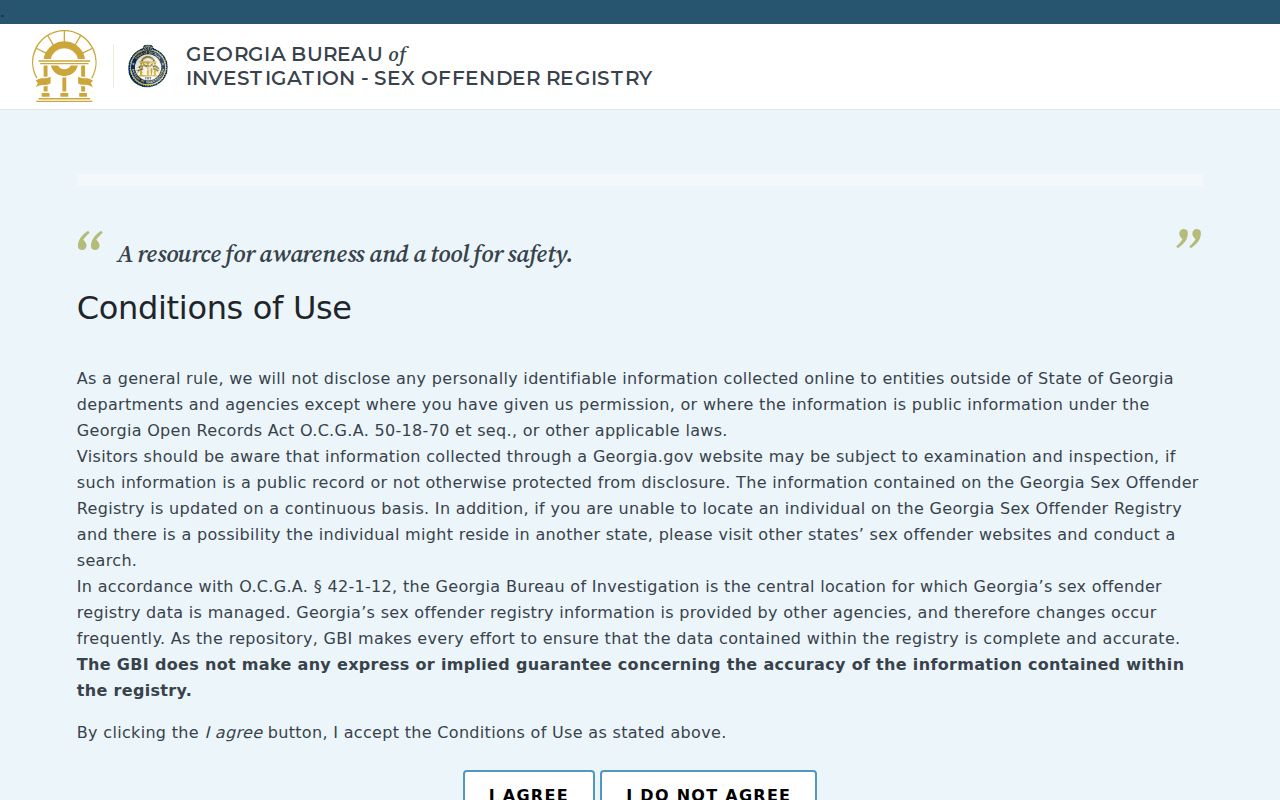
Start with a county filter for neighborhood awareness. Use both name and location methods when spelling, aliases, recent moves, or boundary lines could affect a result.
Polk County OffenderWatch Registry
OffenderWatch and the Georgia registry overlap, but their roles differ. Polk Sheriff's OffenderWatch link offers a local-facing view and may support address-based alerts. The GBI registry is the statewide public record assembled from sheriff submissions. A profile should be checked at the state source when a local map marker or alert needs context. Neither tool replaces direct confirmation by the Polk Sheriff when a status or address appears wrong.
| Channel | Best use | Important limit |
|---|---|---|
| GBI Registry | Authoritative Georgia profile and statewide search | Depends on agency submissions and correct search criteria |
| Polk OffenderWatch | Local map, proximity view, and available notifications | Confirm profile details at the state source or with Sheriff |
| Polk Sheriff | Registration and local status confirmation | Contact the office; do not confront a registrant |
How to Search the Georgia Sex Offender Registry
The public interface supports both identity and geographic searches. A county filter is useful for a broad Polk County registry check, while an exact name can locate a known person. Address and radius tools provide proximity context where enabled. Search results still require careful matching because aliases, similar names, incomplete criteria, and recently submitted changes can affect what appears.
- Open the official registry and read the conditions and misuse warning before searching.
- Enter first and last name, or choose Polk County and add city, ZIP code, address, or radius criteria.
- Review the result list or map and compare the photograph, aliases, physical details, and jurisdiction.
- Open the full profile, read the offense and status fields, then confirm uncertain or urgent information with Polk Sheriff.
| Field Label | Type | Required | Notes |
|---|---|---|---|
| First Name / Last Name | Text | No | Optional name path; spelling and aliases affect matches |
| Offender Type/Level | Dropdown or filter | No | Available classification choices may vary |
| County | Dropdown | No | Choose Polk for a county list |
| City / ZIP | Text or select | No | Narrows a geographic result |
| Address / Radius | Text and distance | No | Supports proximity search where enabled |
| Map / List | View control | No | Changes results presentation |
Why Polk County Registry Searches Miss
No result does not always mean no registration duty. The GBI FAQ identifies several reasons a person may not appear: the person is not legally required to register, a new entry has not yet been submitted, the search criteria are wrong, a deceased person's record was removed, or the person received successful First Offender treatment. Spelling, aliases, and geography can also make a narrow query miss an otherwise public profile.
The official Georgia registry FAQ explains these limits and the state's duties. Its assigned image supports the distinction between a missed search and a legal conclusion.
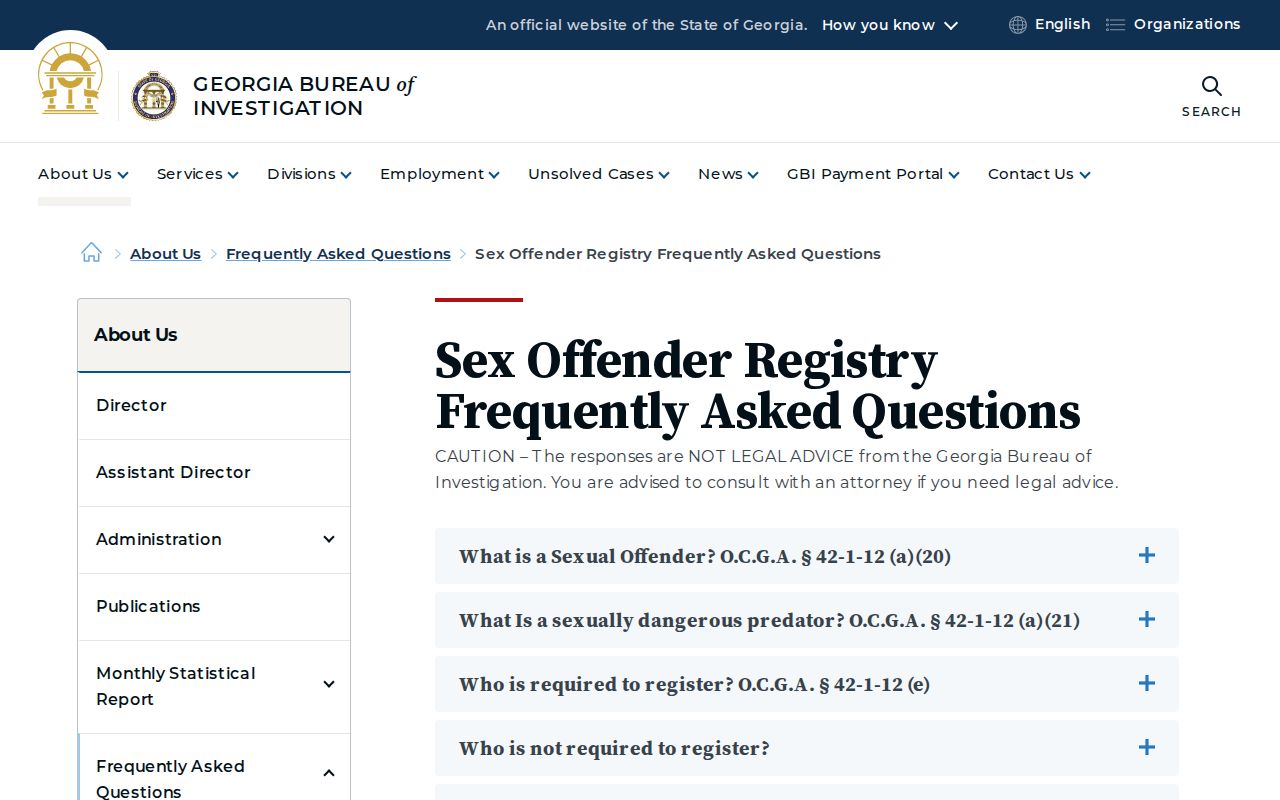
Try broader criteria, check aliases, and use the national layer if a move across state lines may be involved. Ask Polk Sheriff to verify a local concern rather than drawing a conclusion from an empty screen.
Inside a Registry Profile
A public profile can show identity, physical description, location, offense, and registration fields that the law permits for notification. Some values may be blank, historical, or supplied by another agency. Read the displayed status and dates in context. The profile does not reproduce the complete prosecution file, all court pleadings, or a full Georgia criminal history.
| Name & Aliases | Published name variants used to separate and locate records |
|---|---|
| Photo & Physical Description | Photograph, sex, race, birth year or date as allowed, height, weight, hair, eyes, and identifying marks |
| Registered Address | Residence and possibly other statutorily collected location information; confirm current status with Sheriff |
| Offense & Statute | Offense description, legal citation, conviction jurisdiction, and conviction date when supplied |
| Level / Classification | Risk assessment or sexually dangerous predator designation where applicable |
| Registration Status | Jurisdiction, current status, and available verification or compliance information |
Never republish a profile's home address or other personal data. For a court judgment, use the convicting court. For an immediate threat, call law enforcement. A profile supports awareness and safe planning, not a personal investigation at the listed address.
Polk County Sheriff Registry Updates
Georgia law places local registration work with the appropriate sheriff. Covered people generally report before release or placement on supervision and must report required changes. A person moving out of Georgia must notify the last Georgia registering sheriff and register in the new jurisdiction within 72 hours after establishing residence. Sheriffs must send submitted changes within two business days, and GBI says the public registry updates daily.
This sequence creates a short but real timing gap. A person may report to Polk Sheriff before the revised public profile appears. Contact the Sheriff at 1676 Rockmart Highway, Cedartown, 770-749-2900, when the question concerns current county registration. Do not treat an old display as evidence of noncompliance without official confirmation.
Note: Two business days describes the sheriff's update duty, while the state public interface follows its own daily update cycle.
Georgia Registration Levels and Requirements
Georgia does not use a simple public rule in which every tier always expires after a fixed number of years. Risk assessment classifications include Level I, Level II, sexually dangerous predator, and not yet classified. Registration duration and possible release depend on the statute, conviction and release history, supervision, classification, and a court's decision under O.C.G.A. § 42-1-19. A level describes assessed risk; it is not an automatic expiration date.
| Classification | Meaning | Duration / Public Duty |
|---|---|---|
| Level I | Board-assessed low risk | Registration continues unless statutory or court relief applies; classification can support removal analysis |
| Level II | Board-assessed intermediate risk | Registration and notification continue under statute; do not promise a fixed public-page expiration |
| Sexually dangerous predator | Statutory high-risk designation | Enhanced statutory treatment; verify current board and court status |
| Not yet classified | Assessment absent or pending | The person may still have registration duties and a public profile |
Juveniles are generally excluded unless tried and convicted as adults. Successful First Offender treatment can also affect whether a person appears. Those are legal-status questions, not filters a searcher should guess from an absent level.
NSOPW Beyond Polk County Registry
The National Sex Offender Public Website is a federal search that queries participating jurisdiction records. It helps when a person may have moved beyond Georgia or when a community-awareness search crosses a state line. NSOPW is federated, which means its results lead back to the jurisdiction that supplies the profile rather than creating one new national criminal-history file.
The assigned NSOPW image below shows that cross-jurisdiction layer. A national result should be read with the linked state, tribal, or territorial record.
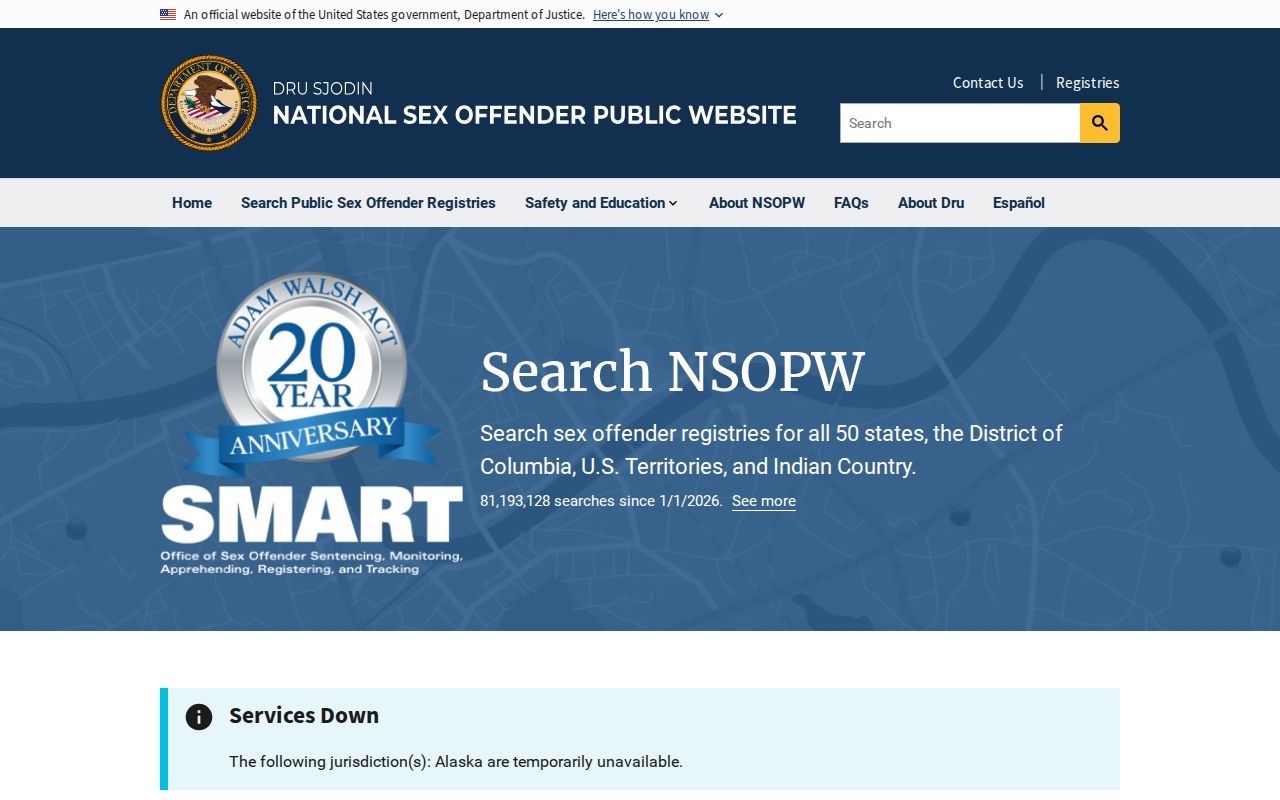
Use NSOPW to broaden geography, then verify a Georgia address or status through GBI and Polk Sheriff. Differences can reflect update timing, participation, or the originating jurisdiction's publication rules.
Polk County Registry Removal Rules
O.C.G.A. § 42-1-19 allows qualifying people to petition Superior Court for release from registration after completing custody and supervision when listed disability or offense conditions apply, or through a broader route tied to ten years after completion or a Level I classification. The statute imposes detailed criteria. Reaching ten years does not erase a profile by itself.
A Georgia conviction petition goes to the convicting Superior Court; an out-of-state conviction generally uses the Georgia county of residence. The district attorney and relevant sheriffs must be served. If relief is denied, another petition generally cannot be filed for two years. Until a court grants relief and the agencies process it, the public should not assume a duty ended because enough time seems to have passed.
Community Notification and Lawful Use
Registry records support informed safety planning. Search the correct area, compare the official profile, use alerts if available, and contact Polk Sheriff when an address looks stale. Do not visit the address, confront anyone, post private details, or attempt to investigate compliance. For an immediate danger, call 911. For a nonurgent status concern, use the Sheriff's published line and describe the profile and discrepancy without circulating it.
Misuse of registry information is prohibited: The Georgia registry warns that its information must not be used to threaten, intimidate, or harass a registrant or the registrant's household. O.C.G.A. § 42-1-12 governs the registry and its lawful notification purpose; report concerns to law enforcement and never confront a listed person.
Registry information can be incomplete or delayed, and a listed offense does not describe every fact in the court case. Use the source for its intended community-notification role. A stale-looking address calls for official verification, not public accusation or vigilantism.